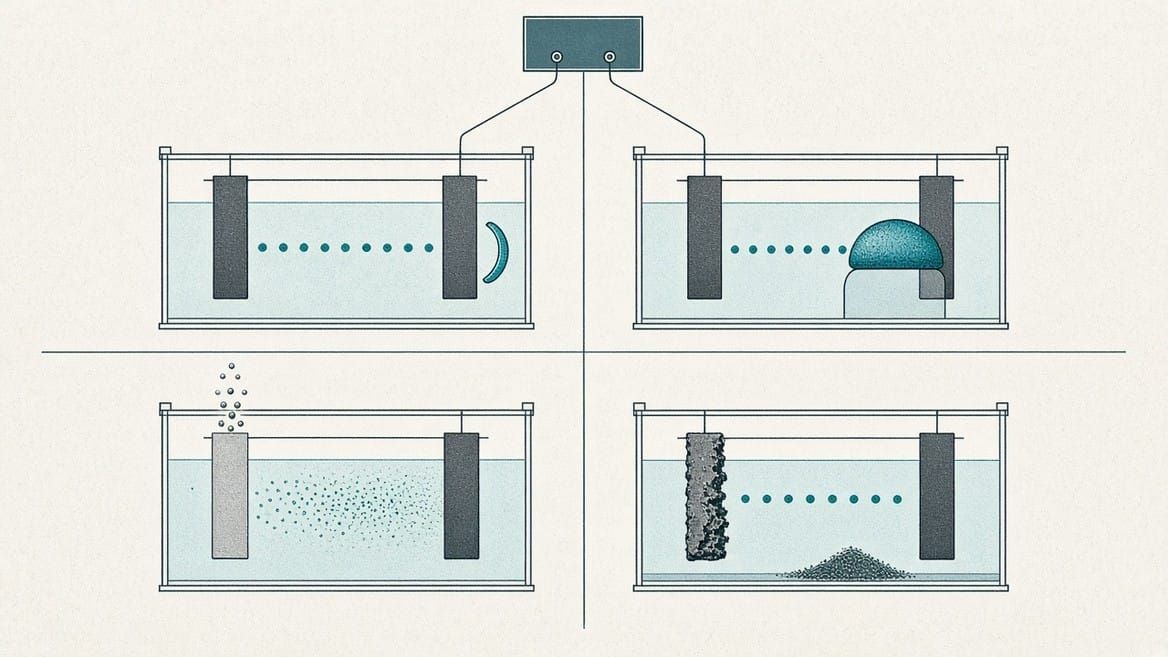
A chrome car bumper, a copper cathode from an Arizona mine, the gold recovered at a copper refinery, and the nozzle plate in an old inkjet printer have one thing in common. Each came out of a tank where an electric current turned dissolved metal ions back into solid metal. The tanks look alike. What goes in and what comes out does not.
There are four main versions of this process: electroplating, electrowinning, electrorefining, and electroforming. The names sound interchangeable, and in pitch decks and grant summaries they often get used that way. This piece walks through all four with an animation, real industrial examples, and one practical question for anyone who makes small metal parts: when does electroforming beat a CNC machine, and when does it not?
One circuit behind all four
Every version uses the same setup. Two electrodes sit in an electrolyte, a liquid that carries dissolved metal ions. A DC power supply connects them. The electrode wired to the positive terminal is the anode. The electrode wired to the negative terminal is the cathode.
Specifically, electrons leave the anode, travel through the external wire and the power supply, and arrive at the cathode. In the liquid, positively charged metal ions, called cations, migrate toward the cathode. When a cation reaches the cathode, it picks up electrons and is reduced to solid metal. A copper ion takes two: Cu²⁺ + 2e⁻ → Cu.
Something has to balance that at the anode, where electrons are being pulled away. That reaction is an oxidation. In three of the scenes below, the anode is a bar of the same metal being deposited, and it dissolves to replace the ions that plate out. In electrowinning, the anode does not dissolve, and water gives up the electrons instead, releasing oxygen gas (Flowers et al., 2019; May et al., 2005).
The amount of metal deposited depends on the electric charge passed. Faraday's constant, 96,485 coulombs per mole of electrons, links the two (Flowers et al., 2019). That is why these processes are slow. The OpenStax chemistry textbook works an example: plating chromium 0.010 mm thick onto 3.3 square meters at 33.46 amps takes about 11 hours. As a result, thickness drives time and cost. That matters later, when we get to CNC machining.
See it move
The animation below runs all four processes in the same tank so the differences are easy to spot. Press Play all for the full tour, use Prev, Next, or the numbered dots to jump between scenes, and press Replay to restart the current scene. Once you click into the animation, the left and right arrow keys change scenes, the space bar plays or pauses the tour, and R replays. On a phone, swipe across the tank.
Here is what happens in each scene, in words.
- Electroplating. A nickel bar is the anode, and a steel car bumper is the cathode. Nickel ions drift toward the bumper and coat it. A zoom circle shows the result: a nickel skin about 0.01 mm thick on steel. The bumper was already a finished part. Plating only changed its surface, while the nickel bar slowly dissolved to resupply the liquid.
- Electroforming. The setup looks almost the same, but the cathode is a mold, called a mandrel. Metal keeps building until it is thick enough to stand on its own, about 1.5 mm in the animation. Then the mold is removed, and a freestanding metal part is left behind. The scene uses a printer nozzle as its example.
- Electrowinning. The scene starts with crushed ore. The ore is leached into a solution, clarified, and concentrated by solvent extraction into a copper-rich liquid. In the tank, the anode is inert. It does not dissolve, and oxygen bubbles rise from it instead. Copper ions plate onto the cathode, so every atom on the cathode came out of the solution, which came out of the ore. The scene notes that zinc, nickel, and cobalt are also won this way.
- Electrorefining. The anode is a slab of impure copper, about 99 percent pure. As it dissolves, copper ions cross to the cathode and plate out at about 99.99 percent purity. Impurities that do not dissolve fall to the bottom of the tank as anode slime, which carries gold and silver.
Electroplating: a thin coat on a part that already exists
Electroplating puts a thin layer of metal on an object, usually to protect it from corrosion or to give it a better finish. Common plating metals include cadmium, chromium, copper, gold, nickel, silver, and tin. Silver and gold tableware, chrome-plated auto parts, and jewelry are everyday examples (Flowers et al., 2019). A 1985 Hewlett-Packard Journal sidebar on electroforming lists jewelry, car bumpers, plumbing fixtures, and printed circuit boards as electroplated items (Siewell et al., 1985).
The textbook case is a silver spoon. The spoon is the cathode, a bar of silver is the anode, and silver ions in the solution carry metal from the bar to the spoon (Flowers et al., 2019).
The defining point is simple: some other process made the part first. Plating changes the surface. Strip the coating off, and the part is still there.
Electrowinning: getting new metal out of ore
Electrowinning recovers metal from a solution made from ore. In copper, it is the last step of a chain often called SX-EW, short for solvent extraction and electrowinning. Ore is leached, often in heaps, and the copper-bearing solution goes through solvent extraction, which concentrates the copper and strips it into a clean electrolyte. That electrolyte goes to the tankhouse, where copper plates onto cathodes at 99.99 percent purity (University of Arizona Superfund Research Center, n.d.; U.S. Department of Energy, n.d.).
The anode is the key difference. It is a permanent, insoluble plate, typically lead (U.S. Department of Energy, n.d.). Electrons still have to come from somewhere at the anode, so water is oxidized. That reaction generates acid and oxygen gas, and the gas produces an acid mist over the cells (May et al., 2005). Because nothing dissolves from the anode, all of the metal on the cathode comes out of the solution.
In the United States, electrowinning is the more common route by plant count. In 2025, the country had 14 electrowon copper refineries and 2 primary electrolytic refineries, and Arizona accounted for about 70 percent of domestic mine production (U.S. Geological Survey, 2026).
Copper is not the only metal won this way. The zinc industry generally uses a lead anode with 0.7 percent silver (Zhang et al., 2019), and researchers have electrowon nickel and cobalt from sulfate solutions (Kazem-Ghamsari & Abdollahi, 2022).
Electrorefining: making existing metal purer
Electrorefining starts with metal that is already metal, just not pure enough. At a primary copper smelter, blister copper of 98.5 to 99.5 percent purity is fire-refined and cast into anodes. In the refinery tank, each anode dissolves, copper deposits on the cathode, and the impurities collect as sludge. The EPA's AP-42 puts the cathode at 99.95 to 99.96 percent copper (U.S. Environmental Protection Agency, 1995). The Department of Energy's copper profile cites 99.99 percent (U.S. Department of Energy, n.d.).
The sludge, called anode slime, is worth a look. It can contain copper, nickel, selenium, tellurium, silver, gold, platinum group metals, and lead, and refineries process it to recover the precious metals (Hait et al., 2009). In other words, the bottom of a copper refining tank is a source of gold and silver.
The animation simplifies one thing. Not every impurity falls neatly to the floor. Some dissolve into the electrolyte, and fine slime particles suspended in the liquid can reach the cathode and lower its purity. A study coauthored by a researcher at Rio Tinto Kennecott Utah Copper, using Kennecott anodes, examined how slime behavior affects cathode purity (Zeng et al., 2016).
Electroforming: the mold is the tool
Electroforming uses plating to make the part itself. The cathode is a mandrel, a precisely made form. Metal deposits on it until the layer is thick enough to stand alone, and then the part is separated from the mandrel. A.J. Tuck Company, an electroforming shop, says the process reproduces the form of the mandrel to within less than a micron and can create close tolerances and surface finishes on inside surfaces (A.J. Tuck Company, 2022). Four examples show where that pays off.
Inkjet nozzles. Hewlett-Packard's ThinkJet printer, described in 1985, used an electroformed nickel orifice plate. The nozzles formed around photoresist pillars on a stainless steel mandrel in a single nickel electroforming step. Each 7-by-7-inch mandrel made 240 potential printheads, the nickel sheet peeled off when done, and the mandrels had been used more than 100 times (Siewell et al., 1985).
Space telescope mirrors. NASA's Marshall Space Flight Center makes thin-walled, full-cylinder X-ray mirrors by electroformed-nickel replication. The mandrel starts as an aluminum blank CNC-machined to near-net shape, then is plated with electroless nickel, diamond turned, and polished (O'Dell, 2015). A nickel shell, in recent work as thin as about 100 micrometers, is electroformed on it and released in a cold-water bath, and the mandrel is cleaned for the next copy. The Marshall team calls replication inexpensive compared with precision figuring and polishing, and much more cost-effective when a design calls for several mirrors of the same shape. They also name the drawback: the replica's figure does not perfectly match the mandrel, especially when the mirror is very thin (O'Dell et al., 2015).
Waveguides. In 1957, the National Bureau of Standards wrote that for millimeter-wave waveguide components, the required tolerances excluded other methods, leaving electroforming as the only suitable technique at the time. The inside dimensions of an electroformed waveguide are a direct function of the accuracy of the mandrel. One listed waveguide, RG-138/U, allowed ±0.0003 inch on its inside dimensions (Feldmann, 1957).
Micro-molds and micro-parts. Since 1998, UV-LIGA has been used to make micromold cavity inserts for injection molding: a photoresist master is electroplated with nickel. Compared with wire electrical discharge machining, the authors report very smooth sidewalls and sharp angles. The same approach makes watch parts directly, including a spring blade 20 micrometers wide in a part 120 micrometers thick (Genolet & Lorenz, 2014). Researchers have electroformed nickel micro gears with features around 70 micrometers (Liu et al., 2017).
When electroforming beats CNC machining
My understanding is that the choice comes down to geometry and quantity. Electroforming tends to win when a part needs:
- Very thin walls. Marshall's mirror shells can be about 100 micrometers thick. A.J. Tuck names thin walls as one of the places where machining, stamping, and casting get pressed beyond their limits (A.J. Tuck Company, 2022).
- Tiny features. Inkjet nozzles, micromold cavities, and 20-micrometer watch springs are made by growing metal into a pattern, not by cutting it away.
- Smooth, accurate internal surfaces. The inside of a waveguide is formed against the outside of a mandrel, which can be measured and polished before any metal goes on.
- Micron-level copies with no tool marks. No cutter touches the part. Its surface copies the mandrel's surface.
- Many identical copies. One mandrel can make many parts: HP's mandrels passed 100 uses (Siewell et al., 1985), and Marshall cleans its mandrels for repeat replications (O'Dell, 2015).
Where CNC machining still wins
- Thick parts. Deposition is slow. The Bureau of Standards put a typical waveguide component at 15 to 25 hours in the tank (Feldmann, 1957), and the OpenStax example needs 11 hours for 0.010 mm of chromium on a large area. Growing a thick, chunky part atom by atom rarely makes sense.
- Simple shapes. A.J. Tuck itself says casting, forging, stamping, machining, and other processes may serve well for most applications (A.J. Tuck Company, 2022). Electroforming earns its place at the limits of tolerance, complexity, and wall thickness.
- One-off parts. Electroforming needs a mandrel first, and the mandrel is usually machined. Marshall's mandrels start as CNC-machined aluminum (O'Dell, 2015), and the 1957 Bureau of Standards guide called machine-shop facilities indispensable (Feldmann, 1957). HP's engineers noted that the work put into a finely detailed mandrel can be amortized over the many parts formed on it (Siewell et al., 1985). With one part, there is nothing to spread the cost across, so machining the part directly is usually simpler.
Why we care about tank chemistry
Thel Consulting works on tech transfer with South Dakota Mines, and the state's push on critical minerals will put more of these processes in front of students, faculty, and founders. Commercial conversations get easier when everyone means the same thing by "refining." Electrowinning makes new metal from ore. Electrorefining cleans up metal that already exists. Electroplating finishes a part. Electroforming makes one.
My desired outcome
Small and specific: the next time someone pitches a plating, refining, or electroforming technology, ask two questions. Where does the metal on the cathode come from, a dissolving anode or the solution? And is that metal a coating, a commodity, or a shaped part? The answers sort almost any tank into one of these four boxes.
Related reading
- $25 Million Proposed for South Dakota Mines Positions the State at the Center of America's Critical Minerals Workforce Push
- Supercapacitor Technology in 2026: Breakthroughs, Industry Leadership, and the Five-Year Outlook to 2031
- Launching Your First Research Lab in Mechanical Engineering: A Practical Guide Adapted for Medical Device Design (And Why It's Basically Entrepreneurship)
- Founders want compute and the bench in one building
References
A.J. Tuck Company. (2022). What is electroforming? https://www.ajtuckco.com/what-is-electroforming
Feldmann, A. A. (1957). Electroforming of waveguide components for the millimeter-wavelength range (National Bureau of Standards Circular 587). National Bureau of Standards. https://www.govinfo.gov/content/pkg/GOVPUB-C13-566c1845025c21f1131f89bacde7c269/pdf/GOVPUB-C13-566c1845025c21f1131f89bacde7c269.pdf
Flowers, P., Theopold, K., Langley, R., & Robinson, W. R. (2019). Chemistry 2e (Section 17.7, Electrolysis). OpenStax. https://openstax.org/books/chemistry-2e/pages/17-7-electrolysis
Genolet, G., & Lorenz, H. (2014). UV-LIGA: From development to commercialization. Micromachines, 5(3), 486–495. https://doi.org/10.3390/mi5030486
Hait, J., Jana, R. K., & Sanyal, S. K. (2009). Processing of copper electrorefining anode slime: A review. Mineral Processing and Extractive Metallurgy, 118(4), 240–252. https://doi.org/10.1179/174328509X431463
Kazem-Ghamsari, A., & Abdollahi, H. (2022). Electrowinning of nickel and cobalt from non-circulated sulfate electrolyte. Transactions of the Indian Institute of Metals, 75(5), 1141–1151. https://doi.org/10.1007/s12666-021-02457-6
Liu, J., Hassanin, H., Ni, Z., Yang, Y., Yang, G., & Jiang, K. (2017). Production of high-precision micro metallic components by electroforming process. Materials and Manufacturing Processes, 32(12), 1325–1330. https://doi.org/10.1080/10426914.2016.1221092
May, G. L., Imrie, B., Young, S., Hisky, B., Miller, J., & Free, M. (2005). Alternative anode reaction for copper electrowinning (Report No. INL/EXT-05-00539). Idaho National Laboratory. https://doi.org/10.2172/911749
O'Dell, S. L. (2015, April 13). X-ray optics at NASA Marshall Space Flight Center [Conference presentation]. EUV and X-ray Optics: Synergy between Laboratory and Space (SPIE 9510), Prague, Czech Republic. NASA Technical Reports Server. https://ntrs.nasa.gov/citations/20150022499
O'Dell, S. L., Atkins, C., Broadway, D. M., Elsner, R. F., Gaskin, J. A., Gubarev, M. V., Kilaru, K., Kolodziejczak, J. J., Ramsey, B. D., Roche, J. M., Swartz, D. A., Tennant, A. F., Weisskopf, M. C., & Zavlin, V. E. (2015). X-ray optics at NASA Marshall Space Flight Center. In Proceedings of SPIE: Vol. 9510. EUV and X-ray optics: Synergy between laboratory and space IV (Article 951003). SPIE. https://doi.org/10.1117/12.2179415
Siewell, G. L., Boucher, W. R., & McClelland, P. H. (1985). The ThinkJet orifice plate: A part with many functions. Hewlett-Packard Journal, 36(5), 33–37. https://hparchive.com/Journals/HPJ-1985-05.pdf
University of Arizona Superfund Research Center. (n.d.). Copper mining and processing: Processing of copper ores. https://superfund.arizona.edu/resources/learning-modules-english/copper-mining-and-processing/processing-copper-ores
U.S. Department of Energy. (n.d.). Energy and environmental profile of the U.S. mining industry: Chapter 5, copper. https://www.energy.gov/sites/default/files/2013/11/f4/copper.pdf
U.S. Environmental Protection Agency. (1995). Primary copper smelting (Section 12.3). In AP-42: Compilation of air pollutant emission factors (5th ed., Vol. 1). https://www.epa.gov/sites/default/files/2020-11/documents/c12s03.pdf
U.S. Geological Survey. (2026). Copper. In Mineral commodity summaries 2026. https://pubs.usgs.gov/periodicals/mcs2026/mcs2026-copper.pdf
Zeng, W., Free, M. L., & Wang, S. (2016). Studies of anode slime sintering/coalescence and its effects on anode slime adhesion and cathode purity in copper electrorefining. Journal of The Electrochemical Society, 163(2), E14–E31. https://doi.org/10.1149/2.0681602jes
Zhang, W., Haskouri, S., Houlachi, G., & Ghali, E. (2019). Lead-silver anode behavior for zinc electrowinning in sulfuric acid solution. Corrosion Reviews, 37(2), 157–178. https://doi.org/10.1515/corrrev-2018-0007